
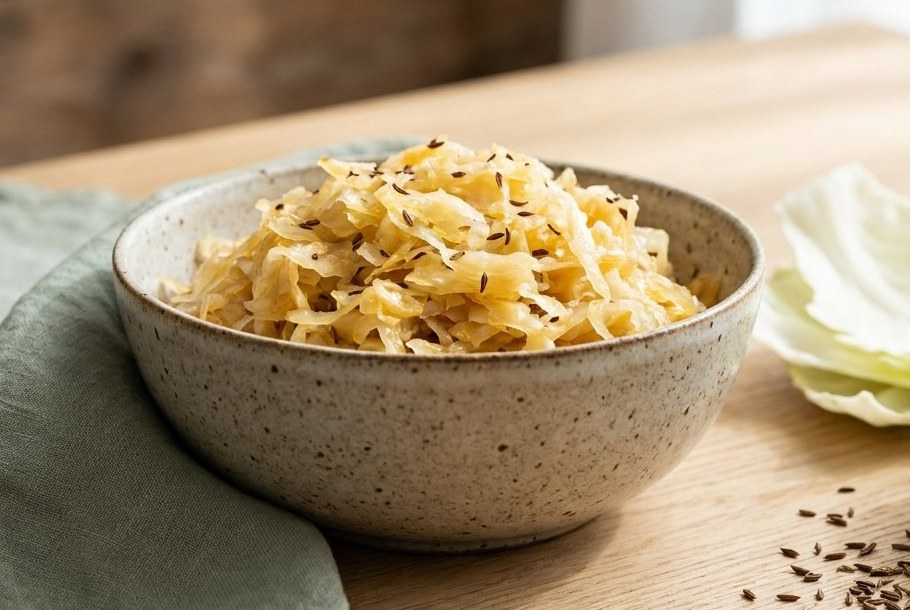
A fermentation project is appealing partly because a simple ingredient can become something different over time. Cabbage, salt and a jar do not look like an elaborate kitchen project, yet the preparation deserves attention. Begin with one tested recipe and follow its quantities, vessel guidance and temperature instructions. This article is an introduction to organising that work, not a replacement for a validated food-safety process. Fermented does not automatically mean safe, and smell alone cannot establish whether a batch is suitable to eat. When a batch is doubtful, do not taste it to decide.
Start with one recipe
Choose a small project that gives you clear instructions from preparation through storage. Read the whole recipe before shopping. Check whether it specifies salt by the weight of vegetables, by the amount of water or by another defined method. Those measurements cannot be exchanged casually. A percentage written beside one method does not necessarily describe another. Keep a kitchen scale available and make a note of the quantities you actually use. If the recipe leaves an essential safety step unclear, choose a better-specified process instead of improvising around the gap.
Make room for the equipment
Set out the vessel, lid, weight or other equipment required by the recipe. Inspect them for damage and clean them as instructed. Plan where the jar will stand and how you will contain any liquid that escapes. A fermentation setup should not depend on a precarious shelf, a loose object balanced above food or a container that is difficult to inspect. If your recipe describes a particular way to allow gas to escape, use that method. Do not tightly seal an improvised vessel and then forget that pressure may build inside it.
Prepare the ingredient consistently
Slice, grate or cut the vegetables as the recipe describes. Size affects how the pieces pack and how they interact with the brine. Keep the preparation consistent enough that you can compare the result with the recipe's description. Remove damaged portions and use sound ingredients. Washing, trimming and packing are part of the process, rather than jobs to hurry through before the interesting part begins. A first batch is not the best place for several untested substitutions. Learn what the stated ingredients do, then seek a tested variation if you want another flavour.
Weigh rather than estimate
Put the container on the scale, reset it as needed and record the relevant weights. Do not replace a specified gram weight of salt with a spoonful judged by eye. Different salts and different spoon shapes can give different amounts. The same applies to the vegetables or water used as the basis for a calculation. If you change the size of the batch, recalculate using the recipe's method and check your arithmetic before filling the jar. Having a written number is more useful than trying to remember whether you added the last portion of salt.
Follow the packing and brine instructions
Some recipes ask you to draw liquid from the vegetables; others begin with a prepared brine. Follow the method you selected. If the instructions require the food to remain submerged, organise the recommended equipment to keep it there and check the setup as directed. Do not assume that adding plain water preserves the original concentration or process. Likewise, adding vinegar to a fermentation recipe changes the conditions and should follow a tested variation. The jar should represent the recipe you intended to make, rather than a series of small corrections whose effect you can no longer reconstruct.
Record the start and the conditions
Label the jar with the recipe, date and batch notes. Keep it in the location and temperature range specified by the process. A warm kitchen and a cooler room may produce different timing, which is one reason a calendar date alone is not a complete set of instructions. Make short observations when the recipe tells you to check the batch. Do not interpret every bubble, colour or aroma from memory of a picture. Use the recipe's expected signs and its guidance on when to stop, discard or seek qualified advice.
Keep changes within tested variations
Spices, sweeteners and alternative vegetables can make a familiar project sound more exciting, but they may also change the process. Use variations that have been tested for the method you are following. A food label or a general claim about fermentation is not enough to establish a safe substitution. This is especially relevant when a recipe moves beyond straightforward vegetables into drinks or other ingredients. Ketogeni's kombucha content, for example, should not be treated as interchangeable with sauerkraut instructions. Each project needs its own process, storage guidance and conservative nutrition estimate.
Treat uncertainty as a reason to stop
If the batch does not match the process, you have missed a critical step or you suspect contamination, do not serve it while hoping that fermentation has solved the problem. Follow the discard guidance of a reliable food-safety source or obtain qualified advice. People with particular health vulnerabilities should ask their clinician whether home-fermented products are appropriate for them. A cooking project is not a treatment, and its appearance does not establish a health benefit. These limits do not remove the pleasure of the project; they give that pleasure a sensible frame.
Finish with a storage plan
Before beginning, check what the recipe requires when fermentation is complete. Refrigeration, suitable containers and any time limits belong to the plan from the start. Label the finished batch and use clean utensils when serving it. You can explore the Classic Sauerkraut and Curtido recipes as possible starting points, while following their complete instructions rather than this general introduction. Think of your first jar as a chance to learn a careful sequence: measure, prepare, pack, observe and store. A record you can repeat is a better result than a dramatic experiment you cannot safely explain.